
November Night Skies 2026: Meteor Showers, Planets, and Autumn Constellations
An observing guide for Harford County, Maryland
As November arrives in Harford County, the nights grow longer and the familiar constellations of autumn gradually give way to the winter sky. Cooler temperatures and earlier sunsets offer amateur astronomers and casual skywatchers more opportunities to explore the heavens.
November 2026 brings several interesting astronomical events, including the Leonid and Taurid meteor showers, a close encounter between Mars and Jupiter, and a full Moon known as the Beaver Moon.
Whether you have a telescope, binoculars, or simply enjoy looking at the night sky, there is plenty to discover this month.
November’s Lunar Phases
The Moon plays an important role in planning astronomical observations. Its brightness can interfere with viewing faint galaxies, nebulae, and meteor showers, while its changing phases offer opportunities to examine lunar surface features.
The principal lunar phases for November 2026 are:
- November 1: Last Quarter Moon
- November 9: New Moon
- November 17: First Quarter Moon
- November 24: Full Moon — Beaver Moon
The November 24 full Moon is also classified as a supermoon, occurring when the Moon is relatively close to Earth in its orbit.
For those interested in viewing lunar craters and mountain ranges, the days surrounding the first quarter are particularly rewarding. Shadows along the boundary between the illuminated and dark portions of the Moon, called the terminator, make surface features easier to distinguish.
Observers interested in faint deep-sky objects should take advantage of the darker evenings surrounding the November 9 new Moon.
Planets Visible During November
Several planets will be visible from Harford County during November, although their viewing times vary.
Saturn — The Ringed Planet
Saturn remains a prominent target in the evening sky. Look generally toward the southern sky after sunset.
Even a modest telescope can reveal Saturn’s rings under favorable atmospheric conditions. November is an excellent time for amateur astronomers to observe the planet before it becomes less conveniently positioned later in the season.
Jupiter — The Giant Planet
Jupiter becomes increasingly prominent in the late-night and early-morning sky throughout November.
Observers using binoculars or small telescopes may be able to see its four largest moons: Io, Europa, Ganymede, and Callisto. Their positions change from night to night as they orbit the planet.
Mars — The Red Planet
Mars is another morning target. It can be recognized by its distinctive orange-red appearance.
Around November 15–16, Mars and Jupiter appear unusually close together in the constellation Leo. The planets will be separated by approximately 1.2 degrees, making this an interesting event for observers using binoculars.
Although the planets appear near each other from Earth, they remain separated by enormous distances in space.
Venus — The Morning Star
Venus returns to the eastern sky before sunrise and becomes increasingly easy to observe as November progresses. Its brilliant white appearance makes it one of the easiest planets to identify.
Uranus — A Distant World
On November 25, Uranus reaches opposition, meaning Earth lies approximately between Uranus and the Sun.
This is one of the best times of the year to observe the distant planet. Uranus will be located in the constellation Taurus. Binoculars and a detailed star chart can help locate it, while a telescope may reveal its small, pale blue-green disk.
November Meteor Showers
November features three notable meteor-shower peaks.
Southern Taurids — November 5
The Southern Taurids are not especially active compared with some other meteor showers, but they are known for occasionally producing bright fireballs.
Northern Taurids — November 12
The Northern Taurids provide another opportunity to observe meteors traveling across the night sky. Like the Southern Taurids, they are generally a low-rate shower.
Leonids — November 16–17
The Leonids are among November’s best-known meteor showers. They are associated with debris left behind by Comet 55P/Tempel-Tuttle.
As Earth passes through this debris, small particles enter our atmosphere at tremendous speeds, producing the streaks of light commonly called shooting stars.
The Leonids are particularly fast-moving meteors, traveling at approximately 44 miles per second.
For the best opportunity to observe them, find an area with a clear view of the sky, preferably away from streetlights. The hours after midnight and before dawn are generally favorable.
Remember that meteor showers can be unpredictable. Even during a peak, observers may see only a few meteors per hour.
Constellations of the November Sky
November is a transitional period between the autumn and winter constellations.
Pegasus — The Winged Horse
The Great Square of Pegasus remains a recognizable feature of the evening sky. Its four prominent stars form a large square-like pattern that can help observers locate other autumn constellations.
Andromeda — Home to a Neighboring Galaxy
The constellation Andromeda is well positioned during November evenings.
Within this constellation lies the Andromeda Galaxy (M31), approximately 2.5 million light-years from Earth.
Under dark conditions, M31 can be detected without a telescope as a faint patch of light. Binoculars provide a better view, while telescopes can reveal additional detail.
Taurus — The Bull
Taurus becomes increasingly prominent in the eastern evening sky.
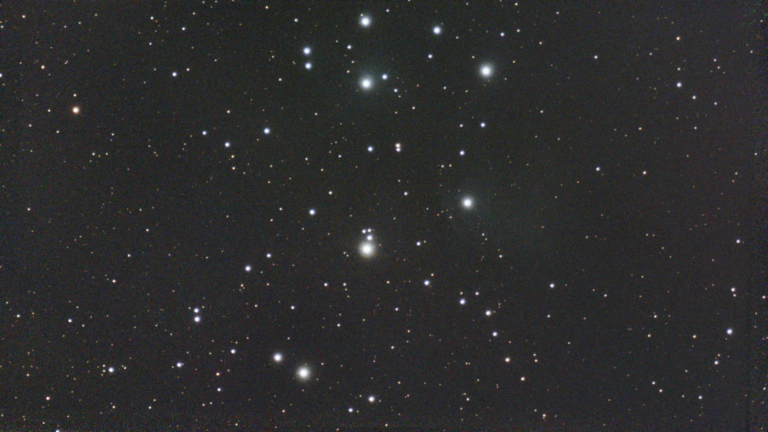
Its bright reddish star, Aldebaran, is one of the easiest stars to identify. Taurus also contains the Pleiades star cluster, commonly called the Seven Sisters.
Orion — The Hunter
By late November, Orion begins appearing prominently in the eastern sky during the later evening hours.
Its three distinctive belt stars form one of the most recognizable patterns in astronomy.
Below Orion’s Belt is the Orion Nebula (M42), a region of active star formation approximately 1,350 light-years from Earth.
Deep-Sky Objects Worth Exploring
November provides excellent opportunities to observe objects beyond our solar system.
The Pleiades (M45)
Located in Taurus, the Pleiades are an open star cluster approximately 440 light-years away.
Several of its bright blue-white stars can be seen with the unaided eye, while binoculars reveal many more.
Andromeda Galaxy (M31)
This neighboring spiral galaxy is an excellent target for binoculars and small telescopes. It provides an opportunity to observe light that has traveled millions of years before reaching Earth.
Double Cluster (NGC 869 and NGC 884)
Located in the constellation Perseus, the Double Cluster consists of two neighboring groups of stars.
It is particularly attractive through binoculars or a telescope using low magnification.
Orion Nebula (M42)
As Orion returns to the nighttime sky, the Orion Nebula becomes one of the most accessible examples of a stellar nursery.
Binoculars and small telescopes can reveal its brighter regions, while astronomical cameras can capture additional detail.
Observing the November Sky from Harford County
Light pollution, weather conditions, and the Moon’s phase can all influence what can be observed from Harford County.
Residents observing from neighborhoods around Bel Air, Aberdeen, Abingdon, and other developed areas may have difficulty seeing faint galaxies and nebulae because of artificial lighting.
However, bright planets, the Moon, and many prominent star clusters remain accessible even under less-than-ideal conditions.
For a successful observing session:
- Allow your eyes approximately 20–30 minutes to adjust to darkness.
- Use a red flashlight to help preserve night vision.
- Dress warmly, especially during late-night and early-morning observations.
- Choose a location with an unobstructed view of the sky.
- Check weather forecasts for cloud cover before setting up equipment.
Binoculars are an excellent starting point for beginning skywatchers. A small telescope can provide additional opportunities to explore planets, lunar features, and brighter deep-sky objects.
Looking Ahead
November’s skies offer a fascinating combination of nearby planetary worlds, distant galaxies, meteor showers, and seasonal constellations.
As autumn progresses toward winter, some of the year’s most recognizable astronomical objects return to the evening sky.
Whether you spend a few minutes outside identifying constellations or an entire evening exploring the heavens through a telescope, November provides many opportunities to appreciate the universe above Harford County.
Clear skies from Harford Science!