
What Is Petrology?
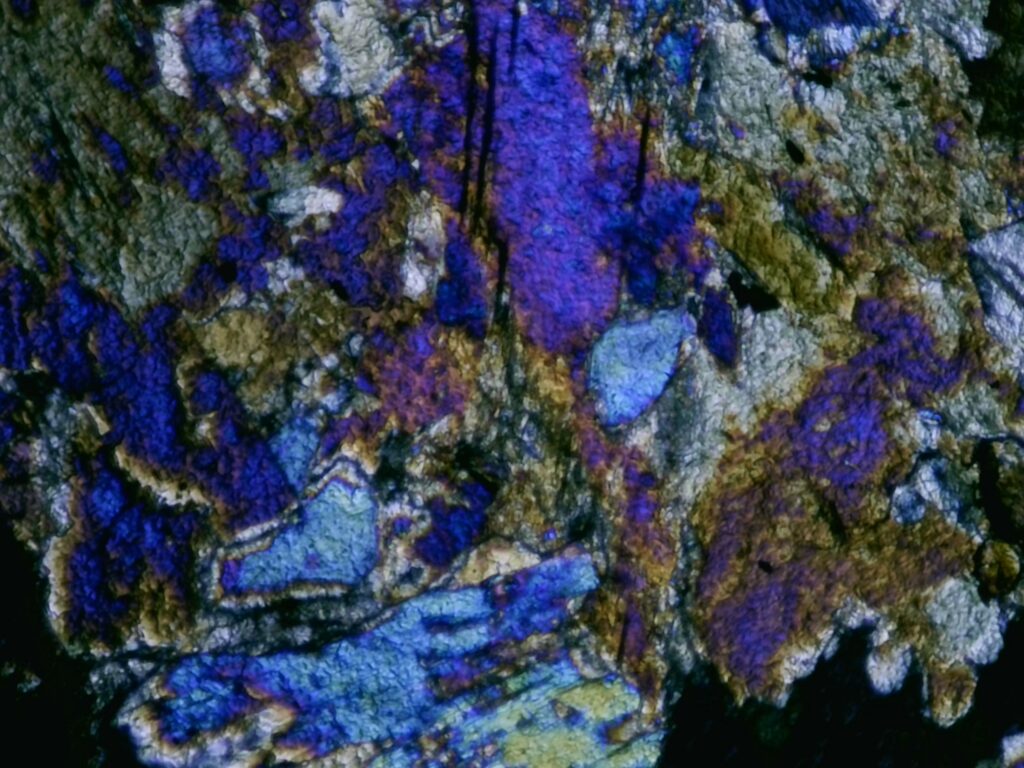
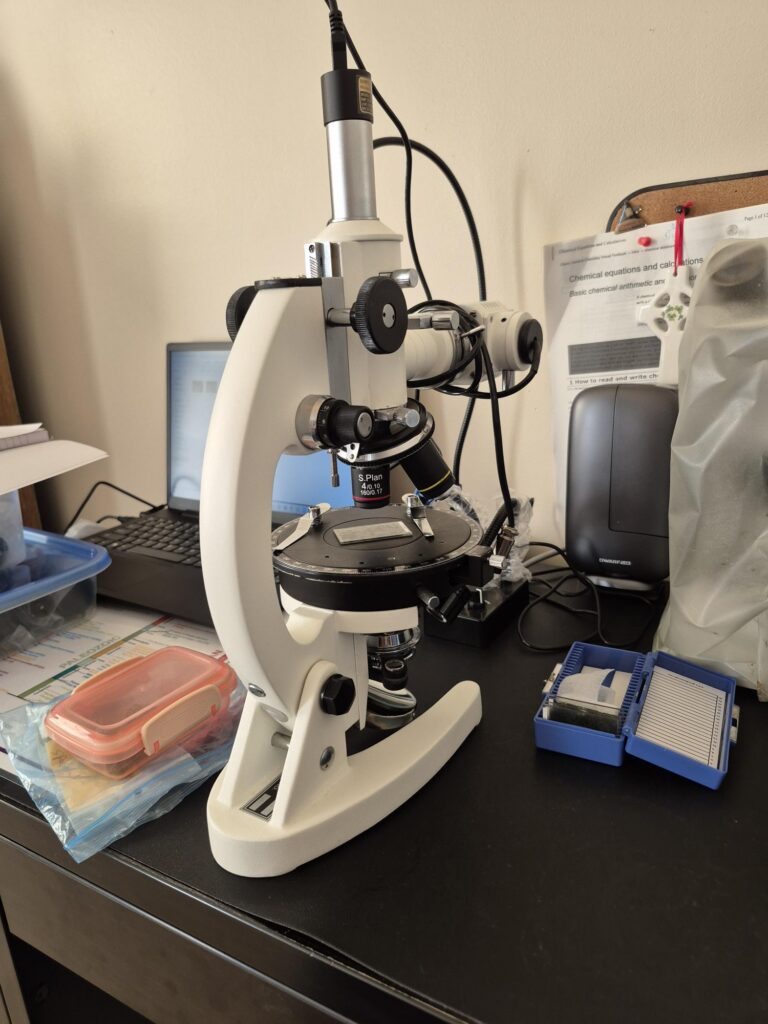
Petrology is the branch of geology that focuses on the study of rocks, including their composition, origin, formation, and the processes that change them over time. Petrologists examine the minerals, textures, and structures within rocks to better understand Earth’s geological history. The field encompasses three major rock types: igneous rocks, formed through the cooling and solidification of molten material; sedimentary rocks, formed through the accumulation and lithification of sediments; and metamorphic rocks, created when existing rocks undergo changes due to heat, pressure, and chemically active fluids. By studying rocks in the field and laboratory, often using specialized instruments such as petrographic microscopes, petrologists gain valuable insights into the dynamic processes that shape Earth’s crust.
1 | What is petrology?
Petrology is the branch of geology concerned with rocks: what they contain, how their minerals and textures are organized, the conditions in which they formed, and the processes that subsequently modified them. Petrology does more than assign a rock name. It uses observations, chemical data, physical principles and geological context to reconstruct a rock’s history. Petrography is the descriptive component of this work—recording mineral assemblages, textures and structures in hand samples and thin sections—whereas petrogenesis focuses on explaining origins and evolution. [1, 2, 8]
The three major branches
Igneous petrology. Studies rocks crystallized from molten material, including intrusive rocks formed at depth and extrusive rocks formed at or near the surface. Grain size, texture, mineral chemistry and bulk-rock composition can help constrain cooling history, magma evolution and emplacement conditions. [1, 3]
Sedimentary petrology. Studies rocks assembled from sediment, biological remains or chemical precipitates. Sediment composition, grain size, sorting, cement, porosity and sedimentary structures can help reconstruct transport, deposition and subsequent diagenesis. [1, 3]
Metamorphic petrology. Studies rocks transformed in the solid state by changes in temperature, pressure, stress and fluid conditions. Mineral assemblages, foliations, reaction textures and equilibrium relationships may preserve a record of metamorphic history. Melting is not required for metamorphism; if substantial melting occurs, igneous processes also become relevant. [1, 3, 8]
How petrologists work
A petrologist begins with the outcrop, structural setting, sample location and hand-specimen description. A thin section then reveals grain-scale relationships that are difficult to see unaided. Depending on the problem, additional methods may include point counting, X-ray diffraction, electron microprobe analysis, whole-rock geochemistry, isotopic dating, and experimental or thermodynamic modeling. Rock classification is strongest when several independent observations agree. [1, 2, 8]
Why this matters locally
For a Harford County sample, petrographic observations can address whether the material has a crystalline interlocking texture, metamorphic fabric, alteration minerals or more than one generation of mineral growth. However, a specimen collected from a quarry stockpile cannot be tied to a named formation solely because it was found at that quarry. A responsible conclusion distinguishes the observed minerals and textures from a proposed rock name and from an independently verified source unit.
2 | What is optical mineralogy?
Optical mineralogy identifies and characterizes minerals by the way they interact with light. In transmitted-light petrography, a rock is ordinarily cut and ground to a thin section approximately 30 micrometers thick, allowing light to pass through many of its grains. The polarizing microscope is designed to record optical properties that depend on composition, crystal structure and grain orientation. Optical observations support identification, but they should be used as a combination rather than treating one color or one texture as proof. [2, 4, 5, 7]
Plane-polarized light (PPL)
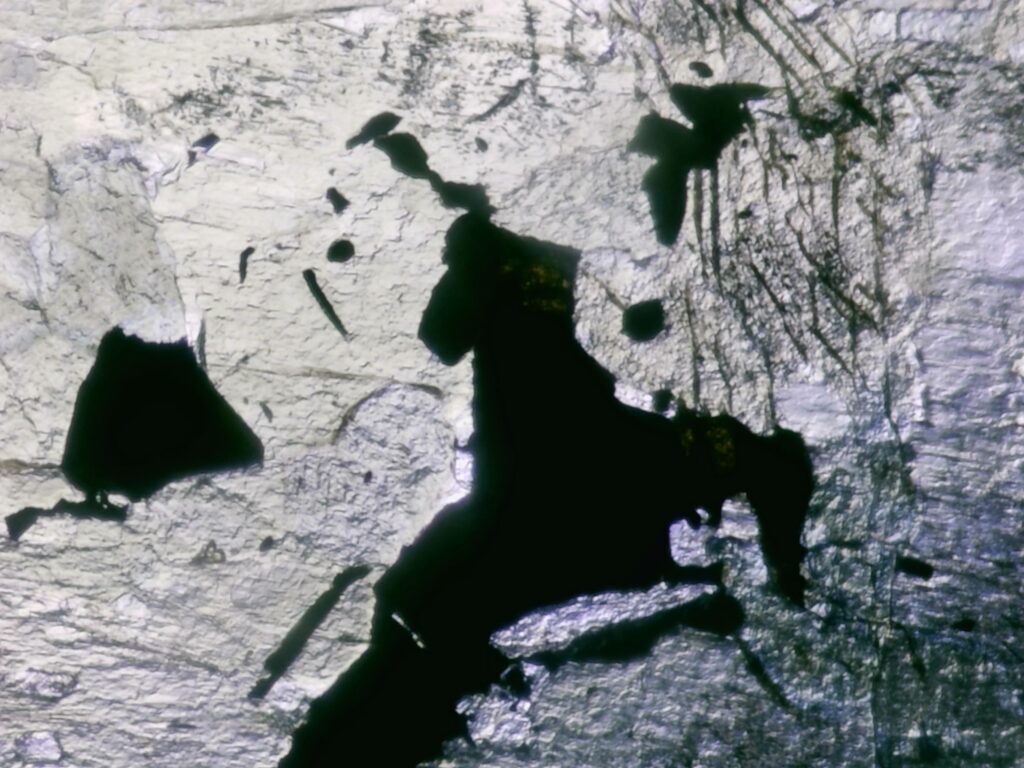
In PPL, the lower polarizer produces light vibrating in one plane; the upper analyzer is removed from the light path. Common observations include grain shape, color, opacity, cleavage, fractures, relief (how strongly a grain stands out from its mounting medium), and pleochroism (a change in absorption color with stage rotation). Colorless minerals may be difficult to distinguish from one another in PPL alone. [2, 4, 5]
Crossed-polarized light (XPL)
In XPL, the analyzer is inserted so its permitted vibration direction is approximately 90° to that of the lower polarizer. Many anisotropic minerals then show interference colors and go dark at extinction positions during stage rotation. Diagnostic features may include twinning, extinction angle, zoning, and interference-color range. Isotropic minerals ordinarily remain dark between crossed polars at all rotations, whereas opaque grains remain dark in both PPL and XPL. Some anisotropic grains can also remain dark in special crystallographic orientations. [2, 4, 5]
Why the colors change
An anisotropic crystal generally transmits two mutually perpendicular components of light at different speeds. Their difference in refractive index is birefringence; the optical path difference (retardation) depends on birefringence, section thickness and viewing direction. After passage through the analyzer, the components interfere to generate colors. Consequently, observed XPL color depends on more than mineral identity. Reliable use of a Michel–Lévy chart assumes a known thickness, appropriate illumination and properly crossed polarizers. [4, 5]
One central rule
Under ideal crossed polars, a given nonexceptional anisotropic grain passes through extinction four times in one full 360° rotation, with adjacent extinction positions 90° apart. Rotation from 225° to 270° to 315° alone is not enough to establish an extinction angle unless the very same grain is tracked, its crystallographic reference direction is recorded and the optical alignment is confirmed. [4, 5]
3 | Working glossary: petrology and optical mineralogy
Petrology — Study of rocks, their composition, origin, history and formation conditions.
Petrography — Systematic description and classification of rocks, including hand-specimen and microscopic observations.
Petrogenesis — Interpretation of the processes by which a rock formed and evolved.
Lithology — Descriptive character of a rock unit or specimen, including composition and texture.
Mineral assemblage — Minerals occurring together within a rock, potentially recording formation conditions.
Texture — Grain-scale size, shape, arrangement and relationships; distinct from larger structural features.
Fabric — Preferred spatial arrangement or orientation of rock components, including foliations and lineations.
Foliation — Planar fabric in a metamorphic rock produced by mineral alignment, compositional layering or both.
Protolith — Original rock from which a metamorphic rock developed.
Recrystallization — Growth or reorganization of crystals within a rock, commonly without wholesale melting.
Alteration — Mineralogical or chemical change after formation, often involving fluids.
Thin section — Rock slice ground to typically about 30 µm thickness, mounted on glass for transmitted-light work.
PPL — Plane-polarized light: polarizer inserted and upper analyzer out.
XPL — Crossed-polarized light: lower polarizer and upper analyzer inserted at right angles.
Polarizer — Optical filter below the sample that selects a single vibration direction.
Analyzer — Second polarizing filter above the sample; inserted for crossed-polars work.
Relief — Visibility of a grain boundary owing largely to the refractive-index contrast with its surroundings.
Refractive index — Ratio of light speed in vacuum to its phase speed in a material.
Pleochroism — Change in observed absorption color of an anisotropic mineral upon rotation in PPL.
Birefringence — Difference between principal refractive indices for light traveling through a crystal in a given direction.
Retardation — Optical path difference accumulated between light components emerging from a birefringent grain.
Interference color — Color generated between crossed polars from the recombination of light components with different phase delays.
Extinction — Darkness of an anisotropic grain at particular XPL orientations; isotropic grains stay dark throughout rotation.
Extinction angle — Angle between a defined grain/crystallographic reference direction and an observed extinction position.
Twinning — Intergrowth of crystal portions related by a specific symmetry operation; may show distinctive XPL patterns.
Isotropic — Same refractive index in all directions; typically dark at all XPL stage angles.
Anisotropic — Optical properties vary with direction; often shows XPL interference colors.
Opaque mineral — A mineral that does not transmit enough light to be visible in standard transmitted-light thin section.
Conoscopic observation — Use of convergent light to examine interference figures and some optical orientation properties.
Bertrand lens — Lens used to view a conoscopic interference figure in appropriately equipped microscopes.
Michel–Lévy chart — Reference chart relating interference color, birefringence and thickness under appropriate conditions.
Modal mineralogy — Volume fraction of constituent minerals, commonly estimated through point counting or image analysis.
Working identification — A testable provisional mineral label rather than a confirmed determination.
4 | References
Numbered citations used in the text are keyed to the following sources. Website URLs are supplied to enable independent comparison with course notes and references. Accessed 3 November 2026.
[1] Johnson, E. A., Liu, J. C., and Peale, M. “1.1 What is Petrology?” Introduction to Petrology (VIVA Open).
https://viva.pressbooks.pub/petrology/chapter/1-1-what-is-petrology
[2] Johnson, E. A., Liu, J. C., and Peale, M. “2.4 Parts of the Petrographic Microscope.” Introduction to Petrology (VIVA Open).
https://viva.pressbooks.pub/petrology/chapter/2-4-parts-of-the-petrographic-microscope
[3] The Open University. “Practising science: Reading the rocks and ecology,” §1.2.2 Rocks. OpenLearn.
https://www.open.edu/openlearn/science-maths-technology/geology/practising-science-reading-the-rocks-and-ecology/content-section-1.2.2
[4] The Open University. “An introduction to minerals and rocks under the microscope,” §2.3.2 Minerals in thin section. OpenLearn.
https://www.open.edu/openlearn/science-maths-technology/an-introduction-minerals-and-rocks-under-the-microscope/content-section-2.3.2
[5] Perkins, D. et al. “5. Optical Mineralogy.” Mineralogy (University of Tennessee at Chattanooga Pressbooks).
https://utc.pressbooks.pub/mineralogy/chapter/optical-mineralogy
[6] Johnson, E. A., Liu, J. C., and Peale, M. “2.5 Common Issues Using a Petrographic Microscope.” Introduction to Petrology (VIVA Open).
https://viva.pressbooks.pub/petrology/chapter/2-5-common-issues-using-a-petrographic-microscope
[7] Federal Highway Administration. Petrographic Methods of Examining Hardened Concrete, chapter 12, “Examination with the Petrographic Microscope” (FHWA-HRT-04-150, 2006).
https://www.fhwa.dot.gov/publications/research/infrastructure/pavements/pccp/04150/chapt12.cfm
[8] Philpotts, A. R., and Ague, J. J. Principles of Igneous and Metamorphic Petrology, 2nd ed., Introduction, Cambridge University Press (2009).
[9] U.S. Geological Survey, Denver Microbeam Laboratory. “Optical Microscopy.”
https://www.usgs.gov/labs/denver-microbeam-laboratory/optical-microscopy
Optical Mineralogy: Ten Common Rock-Forming Minerals
Use this introductory reference to compare minerals in standard thin sections (approximately 30 µm thick), viewed with plane-polarized light (PPL) and crossed-polarized light (XPL). Select any mineral below for all seven observational fields.
Interpretation note: Interference colors and extinction vary with crystal orientation, composition, section thickness, alteration and instrument alignment. A single feature is not proof of identity. Confirm observations using several grains and both illumination modes.
Quick comparison
| Mineral | Typical PPL and relief | Typical XPL colors |
|---|---|---|
| Quartz | Colorless; low | 1st gray–white |
| Plagioclase | Colorless; low | 1st gray–white |
| Microcline (K-feldspar) | Colorless; low | 1st gray–white |
| Orthoclase (K-feldspar) | Colorless; low | 1st gray–white |
| Biotite | Brown/green; moderate | Up to 2nd; often masked |
| Muscovite | Colorless; low–moderate | Bright 2nd |
| Hornblende | Green/brown; moderate–high | 1st–2nd; masked |
| Augite (clinopyroxene) | Pale green/brown; moderate–high | 1st–2nd |
| Olivine | Nearly colorless; high | Bright 2nd–3rd |
| Calcite | Colorless; variable relief | Very high order |
Detailed seven-field mineral reference
Quartz
- PPL appearance
- Colorless and transparent; non-pleochroic.
- Relief
- Low.
- Cleavage and habit
- No cleavage; usually irregular or interlocking grains.
- XPL interference colors
- First-order gray to white.
- Extinction and twinning
- Usually uniform extinction in unstrained grains; undulose extinction common in strained grains. No characteristic twinning.
- Distinguishing diagnostic features
- Lacks cleavage and feldspar-style twinning; often displays undulose extinction.
Plagioclase
- PPL appearance
- Colorless; sometimes cloudy from alteration; non-pleochroic.
- Relief
- Low to moderate.
- Cleavage and habit
- Two nearly perpendicular cleavages, frequently faint; laths and tabular grains.
- XPL interference colors
- First-order gray to white; occasionally pale yellow.
- Extinction and twinning
- Extinction angle depends on composition and orientation. Albite (polysynthetic) twinning often forms parallel stripes.
- Distinguishing diagnostic features
- Albite twinning and sometimes compositional zoning; untwinned grains can resemble quartz.
Microcline (K-feldspar)
- PPL appearance
- Colorless; may be cloudy from alteration; non-pleochroic.
- Relief
- Low.
- Cleavage and habit
- Two nearly perpendicular cleavages, often indistinct; blocky or irregular grains.
- XPL interference colors
- First-order gray to white.
- Extinction and twinning
- Extinction varies across twin domains; characteristic cross-hatched (tartan) twinning may be present.
- Distinguishing diagnostic features
- Tartan twinning and sometimes perthitic intergrowths; absence of tartan twinning does not exclude microcline.
Orthoclase (K-feldspar)
- PPL appearance
- Colorless; often cloudy from alteration; non-pleochroic.
- Relief
- Low.
- Cleavage and habit
- Two cleavages near 90°; tabular or irregular grains.
- XPL interference colors
- First-order gray to white.
- Extinction and twinning
- Simple Carlsbad twins may occur; extinction depends on grain orientation.
- Distinguishing diagnostic features
- Simple rather than tartan twinning; untwinned orthoclase may be hard to distinguish from other feldspars.
Biotite
- PPL appearance
- Brown, yellow-brown, red-brown or green; usually strongly pleochroic.
- Relief
- Moderate.
- Cleavage and habit
- One excellent basal cleavage; thin flakes or plates.
- XPL interference colors
- Up to second-order colors, often masked by strong absorption.
- Extinction and twinning
- Near-parallel extinction relative to cleavage; bird’s-eye or mottled extinction may occur.
- Distinguishing diagnostic features
- Strong pleochroism, flaky habit and single excellent cleavage; zircon inclusions may show pleochroic halos.
Muscovite
- PPL appearance
- Usually colorless; occasionally pale green with weak pleochroism.
- Relief
- Low to moderate.
- Cleavage and habit
- One excellent basal cleavage; plates and flakes.
- XPL interference colors
- Typically bright second-order colors.
- Extinction and twinning
- Near-parallel extinction relative to cleavage; mottled or bird’s-eye extinction may occur.
- Distinguishing diagnostic features
- Colorless mica with one excellent cleavage and bright XPL colors; cannot always be separated from other white micas optically.
Hornblende
- PPL appearance
- Green, brown or yellow-green; usually strongly pleochroic.
- Relief
- Moderate to high.
- Cleavage and habit
- Two prismatic cleavages near 56° and 124° in favorable cross sections; elongated prisms.
- XPL interference colors
- Usually first- to second-order colors, often masked by absorption.
- Extinction and twinning
- Commonly inclined extinction in appropriate longitudinal sections; simple twins possible.
- Distinguishing diagnostic features
- Amphibole cleavage angles and strong pleochroism help distinguish it from pyroxene.
Augite (clinopyroxene)
- PPL appearance
- Colorless to pale green or brown; absent to weak pleochroism.
- Relief
- Moderate to high.
- Cleavage and habit
- Two prismatic cleavages near 87° and 93° in cross section; blocky prisms.
- XPL interference colors
- First- to second-order colors, sometimes reaching upper second order.
- Extinction and twinning
- Commonly inclined extinction in suitable longitudinal sections; simple or multiple twins possible.
- Distinguishing diagnostic features
- Near-90° cleavage, relatively high relief and inclined extinction help distinguish augite from amphibole and orthopyroxene.
Olivine
- PPL appearance
- Usually colorless to very pale yellow; typically non-pleochroic.
- Relief
- High.
- Cleavage and habit
- No visible cleavage in most thin sections; irregular fractures common; equant grains.
- XPL interference colors
- Bright second- to third-order colors.
- Extinction and twinning
- Straight extinction relative to suitable crystal directions; twinning uncommon.
- Distinguishing diagnostic features
- High relief, bright interference colors and fractures without prominent cleavage; alteration commonly follows cracks.
Calcite
- PPL appearance
- Colorless; relief may change conspicuously with stage rotation.
- Relief
- Moderate to high; highly orientation-dependent.
- Cleavage and habit
- Three rhombohedral cleavage directions; irregular carbonate grains.
- XPL interference colors
- Extremely high-order colors, often pale, pearly or washed-out pastels.
- Extinction and twinning
- Lamellar deformation twins common and may be visible in PPL and XPL; extinction depends on orientation.
- Distinguishing diagnostic features
- Extreme birefringence, rhombohedral cleavage and frequent twinning; calcite and dolomite may require staining to distinguish.
Scientific references and further reading
- University of North Dakota: Optical Mineralogy — descriptions and paired PPL/XPL photomicrographs.
- Brock University: Optical Mineralogy — teaching notes, gallery and recognition guides.
- Mineralogy open textbook: Optical Mineralogy — PPL/XPL principles and thin-section methods.
Harford Science educational reference · Version 1.0 · November 2026. This table is an introduction to recognition, not a substitute for comprehensive petrographic analysis.